-
Q. Urination and Bowel Movement
Parents should carefully observe your baby's excretion and record the frequency and characteristics (color/texture). The frequency characteristics not only indicate if the baby is well fed but also indicates if your baby has gastrointestinal discomfort.

There are nine colors in total (color 1 to 6 is abnormal, and color 7 to 9 is normal). If stools are yellow or green color, it is normal. If you notice your baby's stool color is abnormal, please bring your baby to the doctor as soon as possible to get a proper diagnosis of his/her health condition.
The number of times your newborn has bowel movements is not necessary the same every day. It varies by the individual physique, rate of digestion, and the amount of milk that baby drinks. As breastmilk is very easily digest by baby, a breastfed baby will usually have three to eight times of bowel movements a day. It is more frequent than a formula-fed baby. However, when your baby is about one month old, there will be a period of time that the number of the bowel movements of a breastfed baby reduces significantly, it is possible to have a reduction of bowel movement to only once in a few days. If the stool color is normal, texture is soft, no vomiting or bloated stomach issues, etc., and he or she is active and drinks breastmilk as per normal, you should not worry so much.
If your baby's stool texture hardens, turns solid, the number of bowel movements reduce, or even no bowel movements for a few days, gently massage your baby's abdomen clockwise to sooth your baby's digestive system . Alternatively, lift your baby's legs up, insert a thermometer (coated with lubricant such as Vaseline or glycerin) into your baby's anus 1 to 2 cm, rotate gently to stimulate your baby's digestive system to help bowel movements. Consult your healthcare professional if this does not work.
If there are some white particles in your baby's stool, it is mostly because your young baby's digestive system is still developing, results in some substances in the milk that cannot be absorbed and discharged. This will usually improve after six months.
Every baby's stools smell different. After you start weaning your baby, the stools will smell like the food he or she has taken. The smell of his or her stools will be different from babies who are fed on a full-milk diet period. If your the baby’s stools smell significantly different from usual, especially stools with a foul odour, you need to pay extra attention to his or her stool patterns and check if there are any other conditions. Do seek medical attention when necessary. -
Q. Antenatal Check Ups
Make an appointment with your doctor as soon as you know you're pregnant. Antenatal care is important to keep you and your baby healthy throughout the pregnancy. You'll likely see your doctor for the first time in week 5. Most people will have about 10 appointments before baby is due.
Ideally you should visit your doctor with your partner and go armed with both your medical histories. Your doctor will be interested to know about any family medical history that may have an impact on your pregnancy. These include genetic conditions or diseases like diabetes. If you've had previous pregnancies, miscarriages or problems with fertility, your doctor will need to know about these too.
Here is a complete guide of week 1 to 40 of your pregnancy week by week.
There are a series of prenatal tests and scans available to check on the well-being of both mother and baby during pregnancy but not all tests are necessary. Your doctor will be able to advise you on the ones you need.
Apart from the routine tests that are carried out at every antenatal visit such as blood pressure, weight, and urine dipstick for sugar and protein, the following tests are also performed if your doctor considers them necessary.
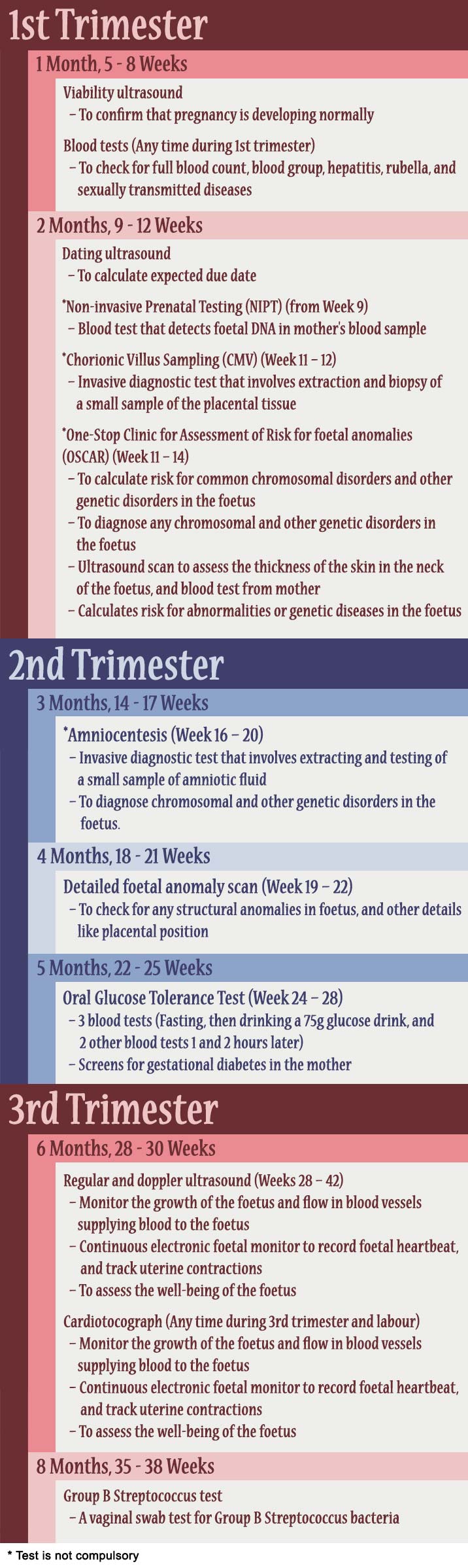
Reference: HealthHub, HealthXchange, KK Women's and Children's Hospital, Mount Elizabeth Hospitals
-
Q. Down Syndrome
What is Down Syndrome?
Down Syndrome is the most common cause of significant mental retardation and learning disability in children.
It is caused by a change in chromosomal number (genetic makeup) in the egg before it is fertilised by the sperm (at the time of conception). This usually occurs due to chance, and is more common in older mothers.
As a result, the fertilised embryo contains an extra chromosome 21 making it three instead of the usual pair (hence the name trisomy 21).
It is important to know that people with Down Syndrome can also have reasonably long and fulfilling lives.
Throughout the world, the frequency of Down Syndrome is about one per 700 births.
The risk of having a baby with Down Syndrome increases as the mother’s age increases.
Screening Tests (FTS or MSS)
Screening tests do not tell you if your baby has Down Syndrome. Their purpose is to tell you if your foetus belongs to a low or high risk group.
If the screening test shows that there is a high risk of your baby being affected, you will be offered a diagnostic test (see below) to confirm it.
Screening tests are noninvasive; hence, there is no risk of miscarriage to the baby.- First trimester screening (FTS) — This consists of a detailed ultrasound scan of your baby at 11–14 weeks gestation to measure the nuchal translucency (NT). NT is the skin at the back of your baby’s neck (Figure 11.2). If this is increased above the normal range, most babies will still be normal although there is an increased risk of Down Syndrome, heart problem or rare genetic syndrome in some babies. Its accuracy is about 80 percent, and increases to 90 percent if maternal blood tests are done as well. This is known as integrated screening.
A result of one in 300 means that 299 out of 300 women with this particular test result will not have an affected baby, and only one will. As you can see, it is not a test for the presence of a Down Syndrome baby, but a way of comparing your chance of having one. So, a 40-year-old woman would be very reassured by a result of one in 800 and a 20-year-old woman may opt for amniocentesis if her result was one in 100 (Figure 11.3).

- Maternal serum screening (MSS) — This measures certain hormones in your blood to determine your risk. These hormones are called alpha-fetoprotein, human chorionic gonadotropin, with or without oestriol. Blood is taken at between 15 - 20 weeks gestation, and a risk value is calculated, individualised to your age. The result of the test is also expressed in terms of a risk assessment (e.g. one in 300).
Overall, about six to seven out of 10 Down Syndrome babies will be detected by the serum screening. However, there will still be some that are undetected and will be born to mothers who have had a “low-risk” result.
These screening tests do not guarantee that the baby will be healthy. It only helps to screen for Down Syndrome. If the test result is “low risk”, this means that the chance of having this condition is reduced.
Important
It must be clearly understood that the results of screening tests represent risks. Increased risk does not mean that the baby is affected and further diagnostic tests must be done.
A low risk does not exclude the possibility of Down Syndrome or other abnormalities as the risk assessment does not detect all affected pregnancies.
Diagnostic Tests (Amniocentesis or Chorionic Villus Sampling)
These are tests that obtain cell samples from the baby and can tell you for sure if the baby is affected with Down Syndrome. It is only performed for high-risk cases detected on screening due to the inherent risks of miscarriage associated with these procedures.
The purpose of diagnosing this condition is to allow the couple the various options of whether to continue with the pregnancy or have an abortion.
Amniocentesis — Down syndrome can be diagnosed early in pregnancy from 15 to 20 weeks of pregnancy by amniocentesis. This involves a very fine needle being passed into the womb, under ultrasound guidance, and sampling of the amniotic fluid (water bag) around the baby. It takes about 2–3 weeks for the results to be ready although rapid tests (PCR) can also be done within 3–5 days. Most women do not find it too uncomfortable and takes about 5–10 minutes as an outpatient procedure. There is a risk of 0.5 percent of a spontaneous miscarriage after the procedure, which usually happens within two weeks after the procedure.
Chorionic villus sampling (CVS) — Chorionic villus sampling is another option that is performed even earlier at about 12 weeks of pregnancy. Like amniocentesis, it is also done under ultrasound guidance. A needle is inserted into the placenta to withdraw the cells through the abdomen or cervix. It allows earlier diagnosis and therefore reduces the anxiety of waiting. The risk of a miscarriage is similar to that of an amniocentesis.
Fetal blood sampling (FBS) — This is a test that involves the sampling of fetal blood from the umbilical cord. The risk of miscarriage is much higher at two to three percent and thus, FBS is rarely performed for the diagnosis of Down Syndrome.
Important
After the amniocentesis or CVS, it is important to return to the hospital immediately if you run a fever, experience any unusual lower abdominal pain, vaginal bleeding or leakage of fluid from the vagina.
Reference: HealthHub -
Q. Diet and Nutrition during Pregnancy
During pregnancy, your baby depends on you as his main source of nutrition. Maintaining a healthy diet during pregnancy will help meet the developmental needs of your baby, maintain your health as well as prepare you for breastfeeding. It can even be said that your nutritional status at the time of conception, in addition to your diet during pregnancy, will affect the health of your grandchildren and future generations.

Recent studies show that chronic conditions such as coronary heart disease, hypertension, type 2 diabetes and obesity, and perhaps osteoporosis, and breast and ovarian cancers, have their origins in the womb. This makes it all the more important for you to eat healthily before, as well as, during pregnancy.
How to have a balanced diet during pregnancy
As a guide, the average energy requirement of a non-pregnant Singapore woman is 1700 kcal per day. During pregnancy, your energy requirement increases by 370 kcal per day in the 2nd trimester and 480 kcal per day in the 3rd trimester.
However, maintaining a balanced diet during pregnancy shouldn't be reduced to counting calories.
Here's a tabular guide on achieving a balanced diet during pregnancy. All you need to do is to ensure that all the food groups are included in your diet, based on the recommended servings.1. rice bowl
2. 250ml cup
3. 10 inch platePregnant women are prone to constipation caused by hormones that relax the gastrointestinal muscles, taking iron supplements, and abdominal fetus compression. It is recommended to consume more whole grains, plenty of fruits and vegetables for dietary fibers to help prevent constipation.
If you have nausea and vomiting in early pregnancy, you should eat a small number of meals and choose low-fat and non-irritating foods. When you wake up in the morning, you can eat grains such as cookies and steamed buns to improve morning sickness. At the end of pregnancy, avoid excessive carbohydrates and fat intake, which will increase body fat.
Reference: HealthXchange
-
Q. Nutrients you need during Pregnancy
During pregnancy, your body requires more than 30 different nutrients. "Seven nutrients, namely vitamin A, vitamin C, folic acid, iron, calcium, vitamin D and DHA (docosahexaenoic acid) are especially important as they help with your baby's development as well as maintain your health
Their recommended dietary allowances (RDA) per day, functions and food sources are detailed in the table below.

Reference: HealthXchange
-
Q. Foods to Avoid during Pregnancy
Food safety is extremely important during pregnancy. This is because bacterial toxins and certain harmful chemicals such as alcohol and methylmercury can pass from mother to baby, and cause undesirable outcomes.
Avoid:
Unpasteurised milk;Soft cheeses, e.g. brie, feta, camembert and roquefort;
Liver pates;
Uncooked hot dogs, ham and luncheon meats
These foods are prone to Listeria monocytogenes, a bacteria that causes listeriosis, which may result in miscarriages and stillbirth.
Avoid:
Raw or undercooked meat,
Poultry,
Seafood, e.g. raw oyster, cockles, sashimi and sushi;
Raw or half-boiled eggs
Raw and undercooked animal foods contain a variety of food-borne bacteria and viruses. Changes in your metabolism and circulation during pregnancy may increase the risk of bacterial food poisoning, and your reaction may be more severe than if you were not pregnant.
Avoid:
Swordfish,Shark,
Tilefish,
King mackerel
Limit:
Canned albacore tuna
Herbal Supplements
Herbal products have not been studied enough to be recommended during pregnancy. Do consult your doctor if you are planning to take these herbs.
Chinese medicine of unknown origin should not be consumed without approval from a qualified TCM practitioner for medicinal use and usage.
Alcohol
Mothers who drink alcohol have a higher risk of miscarriages and stillbirth, and excessive alcohol consumption may result in fetal alcohol syndrome, including facial deformities, low birth weight and mental retardation.
Unwashed Salad and Raw Vegetables Sprouts, including Alfalfa, Clover, Radish, and Mung Beans
Unwashed salads may be contaminated with bacteria from the soil, while raw vegetable sprouts contain high levels of germs, which can be harmful to health.
Reference: HealthHub
-
Q. Pregnancy Weight Gain
Weight control for expectant mothers is very important during pregnancy. Underweight or overweight is bad for both the pregnant woman and baby. It is best to understand how to properly take in nutrients from the early stage of pregnancy and reasonably regulate the weight during pregnancy. The weight gain during pregnancy depends on the weight before pregnancy.
1. Figure Out Your BMI
Your Body Mass Index is a key indicator. You can work it out this way.
Step 1: Note your pre-pregnancy weight in kilos
Step 2: Measure your current height
Step 3: Your BMI = weight divided by height squared2. Check Your BMI Against Recommended Weight Gain

3. Need to Gain Weight? Here's How
Not gaining enough weight increases the risk of a premature birth. One common reason you may find it hard to put on the kilograms is morning sickness — see your doctor if this becomes a problem. Ideally, you should try to eat three main meals a day, plus two or three snacks in-between.
4. Need to Slow Your Weight Gain? Here's How
It's important to note that weight gain is normal in pregnancy, and you should not dive into a radical diet programme at this time. Small, healthy changes to your diet are recommended.
Watch your intake of high-fat or sugary foods with these simple tips:
- Resist the urge to snack on pastries or fried foods like goreng pisang (banana fritters) or curry puffs
- Swap rich milk and cheese for low-fat versions
- When cooking, steam or grill dishes instead of stir-frying
- We often consume more calories from drinks than we expect: steer clear of sugary tea or coffees, and reduce your intake of fruit juices
- Don't forget that a healthy diet should be supported by regular exercise, so stay active with light activities every day, like a brisk walk.

Reference: HealthHub
-
Q. Special Diet - If You are Diabetic During Pregnancy
Diabetes during pregnancy increases the risk of certain health problems like high blood pressure during pregnancy (pre-eclampsia), big baby leading to a difficult delivery and higher chance of needing a cesarean section. Hence, it is important for women with pre-existing diabetes before pregnancy, and those newly diagnosed during pregnancy (i.e. gestational diabetes) to control their blood glucose levels. This will minimise the risk of developing these problems.
There are three steps to manage diabetes during pregnancy, namely, blood glucose monitoring, diet and insulin (if blood glucose levels cannot be controlled by diet alone). Apart from controlling blood glucose levels, the diet should also provide adequate nutrition for the pregnant mother and her baby, resulting in appropriate weight gain similar to that for non-diabetic women.

The diet for diabetes during pregnancy is similar to the healthy diet recommended for all pregnant women, except for the regular distribution and consistent intake of carbohydrate-containing foods (e.g. rice and alternatives, starchy vegetables, fruits and milk) throughout the day.
In other words, you can have three meals and three snacks, with the same amount of carbohydrate-containing foods daily at each meal and snack.
Contrary to popular belief, there is no need for pregnant women to consume glucose or any other sugars for energy, as carbohydrate foods are digested into glucose by the body.
Hence, sugars and sweet foods are not recommended for pregnant women with diabetes, as they are high in carbohydrates, leading to high blood glucose levels, which are often low in nutrients and high in energy, leading to excessive weight gain.
The guidelines for the diet for diabetes during pregnancy can be summarised in the following table. Please see your dietitian for a meal plan specific to your needs.

Reference: HealthHub
-
Q. Special Diet - If You have High Blood Pressure During Pregnancy
For the women suffering from long-standing essential hypertension (even before pregnancy), anti-hypertensive medications and a low-salt diet are advocated to help treat this condition.
Hypertension that arises only during the course of the pregnancy (gestational hypertension or preeclampsia) is characterised by the development of high blood pressure (>140/90 mmHg), swelling of the extremities and proteins in the urine during pregnancy from >20 weeks of pregnancy onwards.

Those who are primiparas (never delivered before), above 35 years of age, with twins or triplets or have pre-existing hypertension or diabetes are at a higher risk of developing this condition. In some instances, this condition has been known to arise during labour or after the delivery of the baby. Many other organ systems can also be affected and notably seizures (eclampsia) can occur in severe cases. When the organ systems are severely affected, they can pose a danger to the mother and fetus.
Treatment entails the delivery of both the baby and the placenta.
- In mild cases, anti-hypertensives may be prescribed to lower the blood pressure while continuing to follow up the pregnancy closely. The baby's wellbeing will be checked regularly through a variety of tests to ensure that it is growing properly and receiving adequate oxygen.
- In severe cases, admission is necessary and a medication known as Magnesium Sulphate may be administered intra-venously to prevent the mother from developing a seizure or fit.
The warning symptoms to this severe condition include severe headaches, visual disturbances, severe nausea and vomiting, and right sided upper abdominal pain. If you suffer from any one of these symptoms after being diagnosed with pre-eclampsia, prompt medical attention is mandatory.
Reference: Healthhub
- In mild cases, anti-hypertensives may be prescribed to lower the blood pressure while continuing to follow up the pregnancy closely. The baby's wellbeing will be checked regularly through a variety of tests to ensure that it is growing properly and receiving adequate oxygen.
-
Q. How to deal with the common discomforts
Frequent Urination
It caused by the pressure on the bladder as the uterus enlarges during the pregnancy.
- Recommend urinating as soon as you feel the urge.
- Increase liquid intake during the day and try cutting back on fluids after dinner to reduce urination at night.
Constipation
Constipation during pregnancy can be caused by the iron supplementation or the enlarged uterus make the small intestine shift and suppress the rectum, which slows down the bowel movements.
- Drink enough water. About 2000cc a day.
- Get adequate exercise. Walk in the morning and evening.
- Eat fibrous vegetables, fruits, and whole grains.
- Get into the habit of having a daily bowel movement.
- Take a stool softener prescribed by a doctor if necessary. Do not take over-the-counter medication on your own.
Nausea and vomiting
In the early stage of pregnancy, the hormonal change results in nausea and vomiting. But symptoms will naturally disappear at the end of the third month for most cases, and only very few will last until delivery.
- Consume dry starchy foods, such as crackers, toast, or cereal, in the morning before you get out of bed.
- Eat small frequent meals and avoid an empty stomach.
- Try not to drink soup or water during meals, don’t lie down flat or move vigorously after eating.
- Avoid food that is oily, not easy to digest or with heavy seasonings.
- If vomiting occurs with morning sickness, rinse your mouth with water to get rid of the taste. You may drink some water to wash the gastric acid away from the esophagus to reduce the burning sensation.
Cramps, swelling on the lower limbs and varicose veins
- Keep the lower limbs warm.
- Increase intake of calcium-rich foods, such as milk, dark green vegetables, dry beans, and anchovies.
- When having cramps, try to straighten the legs. Massage your sole and push toward the calf with hands.
- Do not eat food with high sodium content.
- It is better to rest sideways on the left and elevate your legs to improve blood circulation.
Hemorrhoids
Diarrhea, constipation, and straining during bowel movements which can increase pressure on veins, or the enlarged uterus may block blood flow through veins, which contributes hemorrhoids in pregnancy.
- Develop the habit of regular bowel movement and avoid constipation. Avoid squat hard, or sitting or standing for a long time.
- Take a warm sitz bath.
- A stool softener or topical cream may help to relieve the pain, consult your health care provider when the pain is severe.
- Opt for more whole grains, fresh vegetables and fruits, water in your diet to prevent constipation.
Backache
As the baby grows, the mother's belly enlarges, to maintain balance, the mother's posture shifts, which leads to lower back pain.
- Maintain proper posture. Keep the back straight and do not slouch.
- Try not to carry anything heavy, stand, or sit for a long time or get too tired.
- Use a maternity support belt to support the belly and lighten the load on the back.
- Use a hot compress, massage for waist or back to increase blood circulation.
Heartburn
During pregnancy, the hormone progesterone causes the esophageal sphincter to relax which allows stomach acid to pass into the esophagus and results in a burning sensation.
- Take multiple meals with a small amount of food for each meal. Avoid eating too fast or too much.
- Avoid eating desserts and greasy, heavy, or fried food.
- Avoid wearing tight clothes or belts to decrease the chances of gastroesophageal reflux.
- It is appropriate to keep a semi-Fowler's position after dinner instead of lying down immediately.
- You can take antacids or antiemetic (anti-sickness) drugs under a doctor's guidance.
Tooth and Gum Disease
Tooth decay, gingivitis, gingival hyperplasia during pregnancy, the periodontal (gum) disease worsens because during pregnancy, the Estrogens in the body increase, causing swelling of the mucous membranes, which is prone to bleeding from the mouth or gums.
- Practice good oral hygiene.
- Visit your dentist regularly (teeth cleaning to remove plaque and - tartar for pregnant women) and talk to your dentist as soon as any oral health conditions occur.
- Use the soft-bristled toothbrush and brush gently.
- Include enough fresh fruit and vegetables in your diet to ensure adequate vitamin C intake to protect your gum health.