-
Q. What is special about goat milk from New Zealand?
New Zealand's dairy goats are mainly fed green and lush pastures. The high quality of milk corresponds directly to the quality of feed that the goats consume. In most other countries of the world, goats are fed on processed meal and grain.
New Zealand has a strict Code of Welfare for Goats. It specifies what is considered to be optimal animal welfare and how this may be achieved for goats farmed under New Zealand conditions. DGC farms are required to follow the New Zealand Code of Welfare for Goats as well as DGC's own Code of Farm Practice.
You can be assured you & your family are getting the best quality goat milk formulas!
-
Q. Who can benefit from goat milk?
Goat milk may be suitable for people of different ages provided there is no allergy to goat milk proteins. It can be a good option for
- People looking to support their overall wellbeing & strengthen their natural defences can benefit from the nutrition in goat milk.
- Individuals who have poor digestion or face difficulty digesting cow milk.
- Those with cow milk allergy.
- Parents looking for a more natural, less processed alternative to other formulas.
- Goat milk formula is considered safe for infants under 1 year old.*
- Children over 1 year old who are beginning to explore the world can benefit from goat milk, which can help support their natural defenses.
- Children with digestion problems or sensitive tummies, e.g. unsettledness, discomfort, colic
- Children who are not growing well with cow milk or soy milk products.
Please consult your healthcare professional for further advice.
*In 2012, a clinical study prompted the European Commission to update its guidelines, allowing the use of goat milk-based infant formula. Karihome supports World Health Organization’s recommendation to exclusively breastfeed your infant for the first six months of life and after six months of age, your infant should receive age-appropriate foods while breastfeeding continues for up to two years of age or beyond. Kindly consult your healthcare professional before deciding to formula feed your infant or if you have difficulty breastfeeding.
-
Q. Is goat milk suitable for people with lactose intolerance?
Lactose is the name of a specific carbohydrate or sugar of milk. All milk from mammalian species (cows, goats, sheep, and humans) contains lactose, which is the major carbohydrate in the milk of most species.
Often there is confusion about lactose intolerance and it can be incorrectly diagnosed. Sometimes cow milk protein intolerance (CMPI) could be misdiagnosed as lactose intolerance.
Some people who believe they are lactose intolerant find goat milk an agreeable product. Goat milk contains oligosaccharides similar in structure to human milk oligosaccharides.1 Oligosaccharide concentrations in goat milk from New Zealand are approximately 10 times higher than cow milk.2 These oligosaccharides may influence how lactose is metabolized.
If you are lactose intolerant, do consult your healthcare professional before trying a milk formula containing lactose.
Disclaimer: The information provided in this article is meant purely for educational purposes and may not be used as a substitute for medical diagnosis or treatment. You should seek the advice of your doctor or a qualified healthcare provider before starting any treatment or if you have any questions related to your health, physical fitness or medical condition.
References:
1 Martinez-Ferez et al. 2006; Meyrand et al 2013; Kiskini and Difilippo, 2013; Thum et al 20152 Thum et al 2015; Martinez-Ferez et al. 2006; Meyrand et al 2013; Kiskini and Difilippo, 2013
-
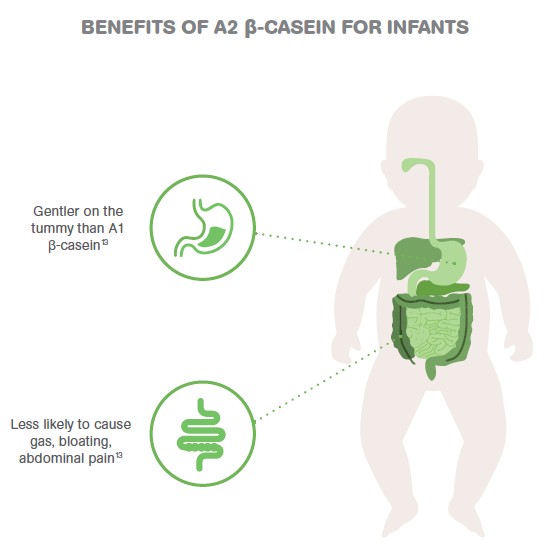
Q. Why is goat milk gentle on the tummy?
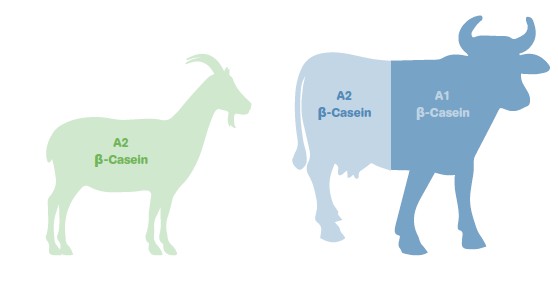
Goat milk naturally contains A2 β-casein, whereas standard cow milk formulas can contain a mixture of A1 β-casein and A2 β-casein. 1,2
-
Q. Advantage of goat's milk - Easy to digest and absorb
The study has shown that trypsin in the human stomach can only break down 76% to 90% of cow's casein and 96% of the casein in goat's milk. Even for the most difficult to digest β-Lactoglobulin (β-LG), the digestion rate for goat milk is three times higher than cow milk. The casein found in goat's milk is mainly β-casein (about 70%). The main characteristic of β-casein is having a high proportion of proline, in which the molecular appears more amorphous and loosely arranged. Because of that, the size of the casein micelles of goat milk tends to be larger, and the gap among them is relatively bigger, which allows the digestive enzymes to enter easily, and this improves the breakdown ability of digestive enzymes significantly. This unique structure of goat milk allows more efficient digestion compared with cow milk.

Not only is goat milk easy to digest, it also contains more medium-chain fatty acids (MCFA), which converts to energy more quickly especially for babies. Among all the nutrients, fat is the most difficult to digest. As goat milk contains more MCFA, milk fat is easily digested and absorbed compared with LCFA (long-chain fatty acids). In the goat milk fat, there is a high percentage (about 10-20%) of MCFA (e.g. caprylic acid and capric acid), which can convert into energy more quickly.
References:
1. Jasińska, B. The comparison of pepsin and trypsin action on goat, cow, mare and human caseins. Rocz. Akad. Med. Bialymst. 1995, 40, 486-496
2. Almaas H, Cases AL, Devold TG, Holm H, Langsrud T, Aabakken L, Aadnoey T, Vegarud GE. In vitro digestion of bovine and caprine milk by human gastric and duodenal enzymes. Int. Dairy J, 01 Sep 2006, 16(9):961-968
3. Prosser C. (2003). Casein composition of human milk and goat and cow milk powders. Summary paper prepared in April 2003, AgResearch, New Zealand.
4. C G Prosser 1, V I Svetashev, M V Vyssotski, D J Lowry. Composition and distribution of fatty acids in triglycerides from goat infant formulas with milk fat. J Dairy Sci., 2010 Jul;93(7):2857-62
-
Q. Advantage of goat's milk - Multiple natural nutrients
Among many other valuable properties and components of goat's milk, here are some natural nutrients and its functions:
Synergy 1 (oligofructose-enriched inulin)
- Inulin+ Fructooligosaccharides (FOS), use a unique ratio to become Synergy 1 oligofructose-enriched inulin
- Derived from natural fruits and vegetables, with a mild fruity aroma
- A natural dietary fiber, stimulates the bifidobacteria, resulting in a significant increase of beneficial bifidobacterial in the intestinal tract. At the same time, the presence of less desirable bacteria is significantly reduced.
Taurine
- Derived from Methionine and Cysteine, it helps to support overall mental and physical development.
Choline
- Helps support overall mental functioning.
- Inulin+ Fructooligosaccharides (FOS), use a unique ratio to become Synergy 1 oligofructose-enriched inulin
-
Q. Advantage of goat's milk - Reduce gastrointestinal discomfort and allergies
Goat milk protein contains more β-casein, which forms fine and porous milk curds. Its unique structure allows more efficient digestion of goat milk protein, is easier to be absorbed and may help to reduce gastrointestinal discomfort conditions in babies (e.g. skin rashes, milk reflex etc). In general, cow milk formula needs additional processing to make its milk protein smaller or easier to be digested, such as adding whey or hydrolyzing it. As goat milk proteins are naturally fine and delicate, no additional processing is required. Fine milk proteins are easy to digest and absorb.
Goat milk fat contains essential nutrition that supports baby's growth: More Medium Chain Fatty Acids (MCFA) makes milk fat easier to be digested and converted to energy faster. Natural Sn-2 PA is easily absorbed & digested and does not cause hard stools & calcium soap formation. Natural Sphingolipid, Vitamin A, D, E, K are naturally inherent and rich in goat milk.
Most allergic reactions are caused by genetics and in part by food and environmental factors. Food allergies mainly caused by certain allogeneic proteins. Environmental factors generally have pollen, pet dander, sometimes hot water, and sunlight can also cause skin irritation. Goat milk contains less αs1-casein & may reduce the incidence of skin discomfort and gastrointestinal disorder caused by cow milk allergy.
Disclaimer: The information provided in this article is meant purely for educational purposes and may not be used as a substitute for medical diagnosis or treatment. You should seek the advice of your doctor or a qualified healthcare provider before starting any treatment or if you have any questions related to your health, physical fitness or medical condition.
-
Q. Advantage of goat's milk - Bone strength
Goat milk is naturally rich in calcium and other minerals. Many studies demonstrate more efficient uptake of calcium, phosphorus, iron, copper, zinc, magnesium and selenium from goat compared to cow milk when gut absorption is compromised.1 Calcium absorption was greatest in diets containing casein from goat milk compared to a diet containing no casein, indicating that casein is needed for calcium absorption from goat milk.2 Diets with goat milk also built up more calcium deposits and stronger bones in young animals.3 This has been linked to reduced loss of bone mineral density and bone strength later in life. In another study, goat milk improved bone health4 in animals with low iron stores.
References:
1 Barrionuevo et al, 2002; Alferez et al, 2003; Campos et al, 2003; Lopez-Aliaga et al, 2003
2 McKinnon et al, 2010
3 Kruger et al 2008
4 Diaz-Castro et al, 2011